

- David Salinas, Valentin Flunkert, Jan Gasthaus, Tim Januschowski (2020). “DeepAR: Probabilistic forecasting with autoregressive recurrent networks”. International Journal of Forecasting.
- Alexander Alexandrov et. al (2020). “GluonTS: Probabilistic and Neural Time Series Modeling in Python”. Journal of Machine Learning Research.
Exogenous Variables, Losses, and Parameters Availability Given the sampling procedure during inference, DeepAR only supportsDistributionLossas training loss. Note that DeepAR generates a non-parametric forecast distribution using Monte Carlo. We use this sampling procedure also during validation to make it closer to the inference procedure. Therefore, only theMQLossis available for validation. Aditionally, Monte Carlo implies that historic exogenous variables are not available for the model.
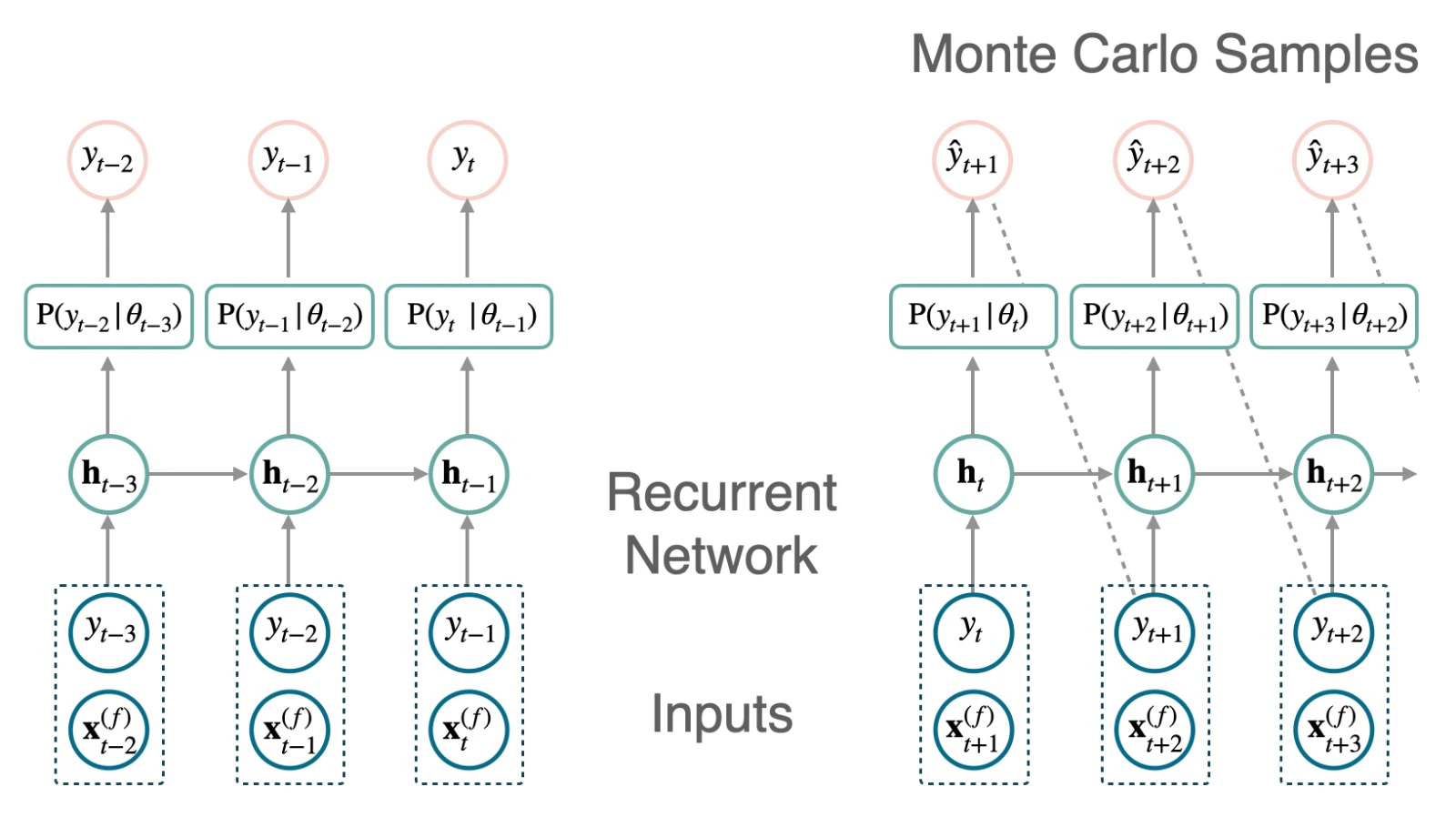
1. DeepAR
DeepAR
BaseModel
DeepAR
Parameters:
DeepAR.fit
fit method, optimizes the neural network’s weights using the
initialization parameters (learning_rate, windows_batch_size, …)
and the loss function as defined during the initialization.
Within fit we use a PyTorch Lightning Trainer that
inherits the initialization’s self.trainer_kwargs, to customize
its inputs, see PL’s trainer arguments.
The method is designed to be compatible with SKLearn-like classes
and in particular to be compatible with the StatsForecast library.
By default the model is not saving training checkpoints to protect
disk memory, to get them change enable_checkpointing=True in __init__.
Parameters:
Returns:
DeepAR.predict
Trainer execution of predict_step.
Parameters:
Returns:
Usage Example
2. Auxiliary functions
Decoder
Module
Multi-Layer Perceptron Decoder
Parameters: