

- Olivier Sprangers, Sebastian Schelter, Maarten de Rijke (2023). Parameter-Efficient Deep Probabilistic Forecasting. International Journal of Forecasting 39, no. 1 (1 January 2023): 332–45. URL: https://doi.org/10.1016/j.ijforecast.2021.11.011.
- Shaojie Bai, Zico Kolter, Vladlen Koltun. (2018). An Empirical Evaluation of Generic Convolutional and Recurrent Networks for Sequence Modeling. Computing Research Repository, abs/1803.01271. URL: https://arxiv.org/abs/1803.01271.
- van den Oord, A., Dieleman, S., Zen, H., Simonyan, K., Vinyals, O., Graves, A., Kalchbrenner, N., Senior, A. W., & Kavukcuoglu, K. (2016). Wavenet: A generative model for raw audio. Computing Research Repository, abs/1609.03499. URL: http://arxiv.org/abs/1609.03499. arXiv:1609.03499.
1. BiTCN
BiTCN
BaseModel
BiTCN
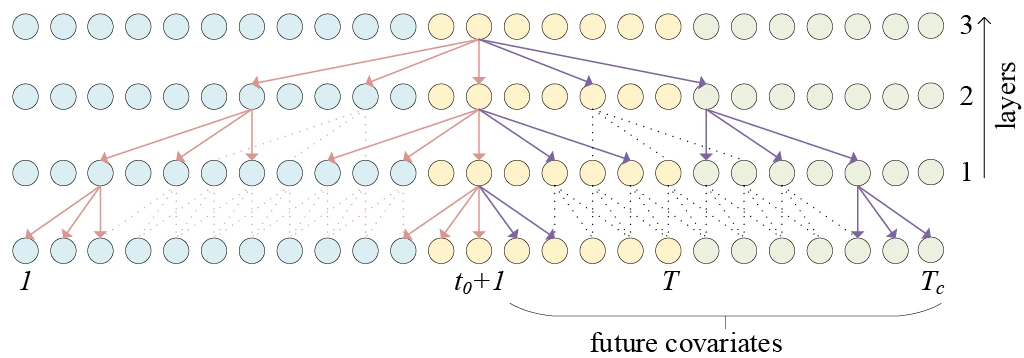
Bidirectional Temporal Convolutional Network (BiTCN) is a forecasting architecture based on two temporal convolutional networks (TCNs). The first network (‘forward’) encodes future covariates of the time series, whereas the second network (‘backward’) encodes past observations and covariates. This is a univariate model.
Parameters:
BiTCN.fit
fit method, optimizes the neural network’s weights using the
initialization parameters (learning_rate, windows_batch_size, …)
and the loss function as defined during the initialization.
Within fit we use a PyTorch Lightning Trainer that
inherits the initialization’s self.trainer_kwargs, to customize
its inputs, see PL’s trainer arguments.
The method is designed to be compatible with SKLearn-like classes
and in particular to be compatible with the StatsForecast library.
By default the model is not saving training checkpoints to protect
disk memory, to get them change enable_checkpointing=True in __init__.
Parameters:
Returns:
BiTCN.predict
Trainer execution of predict_step.
Parameters:
Returns:
Usage Example
2. Auxilary functions
TCNCell
Module
Temporal Convolutional Network Cell, consisting of CustomConv1D modules.
CustomConv1d
Module
Forward- and backward looking Conv1D