

NHITS/NBEATSx to extract
these series’ components. We will:- Installing NeuralForecast.
- Simulate a Harmonic Signal.
- NHITS’ forecast decomposition.
- NBEATSx’ forecast decomposition.
You can run these experiments using GPU with Google Colab.

1. Installing NeuralForecast
2. Simulate a Harmonic Signal
In this example, we will consider a Harmonic signal comprising two frequencies: one low-frequency and one high-frequency.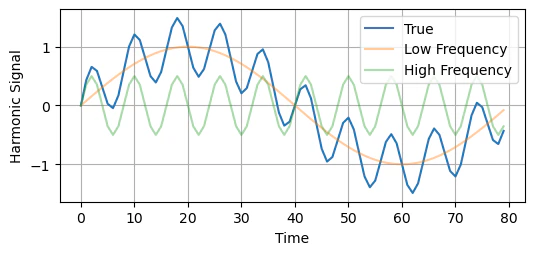
3. NHITS decomposition
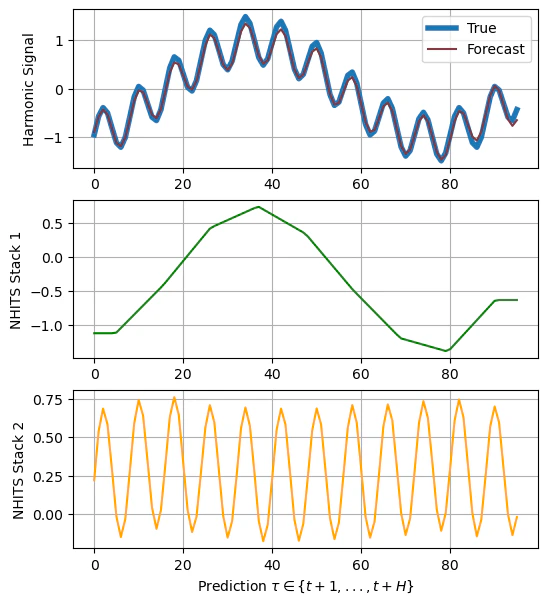
We will employNHITS stack-specialization to recover the latent
harmonic functions.
NHITS, a Wavelet-inspired algorithm, allows for breaking down a time
series into various scales or resolutions, aiding in the identification
of localized patterns or features. The expressivity ratios for each
layer enable control over the model’s stack specialization.
4. NBEATSx decomposition
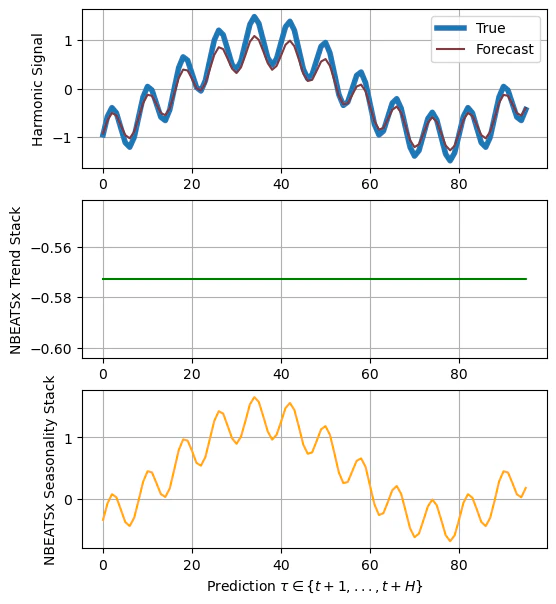
Here we will employNBEATSx interpretable basis projection to recover
the latent harmonic functions.
NBEATSx, this network in its interpretable variant sequentially
projects the signal into polynomials and harmonic basis to learn trend
and seasonality components:
In contrast to NHITS’ wavelet-like projections the basis heavily
determine the behavior of the projections. And the Fourier projections
are not capable of being immediately decomposed into individual
frequencies.
References
- Cristian Challu, Kin G. Olivares, Boris N. Oreshkin, Federico
Garza, Max Mergenthaler-Canseco, Artur Dubrawski (2023). NHITS:
Neural Hierarchical Interpolation for Time Series
Forecasting.
- Boris N. Oreshkin, Dmitri Carpov, Nicolas Chapados, Yoshua Bengio
(2019). “N-BEATS: Neural basis expansion analysis for interpretable
time series forecasting”.
- Kin G. Olivares, Cristian Challu, Grzegorz Marcjasz, Rafał Weron, Artur Dubrawski (2021). “Neural basis expansion analysis with exogenous variables: Forecasting electricity prices with NBEATSx”.