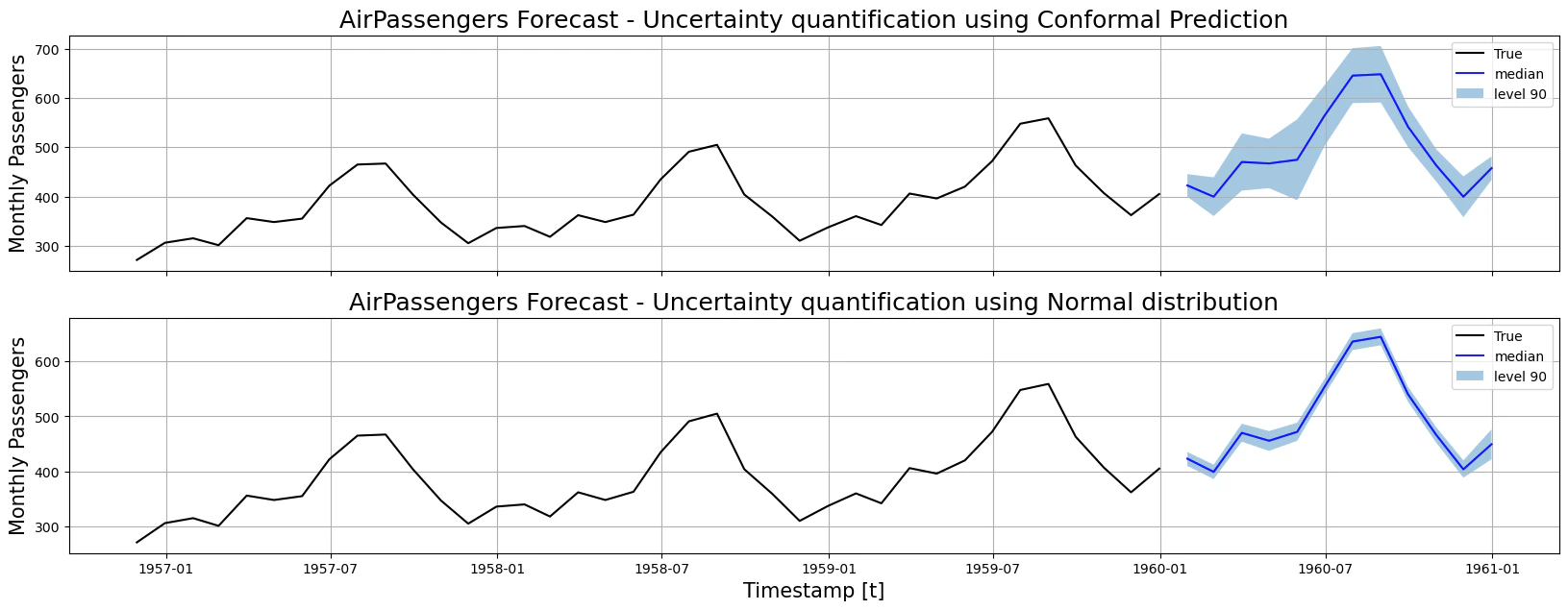
fig, (ax1, ax2) = plt.subplots(2, 1, figsize = (20, 7))
plot_df = pd.concat([AirPassengersPanel_train, preds])

plot_df = plot_df[plot_df['unique_id']=='Airline1'].drop(['unique_id','trend','y_[lag12]'], axis=1).iloc[-50:]

ax1.plot(plot_df['ds'], plot_df['y'], c='black', label='True')
ax1.plot(plot_df['ds'], plot_df['NHITS'], c='blue', label='median')
ax1.fill_between(x=plot_df['ds'][-12:],
                 y1=plot_df['NHITS-lo-90'][-12:].values,
                 y2=plot_df['NHITS-hi-90'][-12:].values,
                 alpha=0.4, label='level 90')
ax1.set_title('AirPassengers Forecast - Uncertainty quantification using Conformal Prediction', fontsize=18)
ax1.set_ylabel('Monthly Passengers', fontsize=15)
ax1.set_xticklabels([])
ax1.legend(prop={'size': 10})
ax1.grid()

ax2.plot(plot_df['ds'], plot_df['y'], c='black', label='True')
ax2.plot(plot_df['ds'], plot_df['NHITS1'], c='blue', label='median')
ax2.fill_between(x=plot_df['ds'][-12:],
                 y1=plot_df['NHITS1-lo-90'][-12:].values,
                 y2=plot_df['NHITS1-hi-90'][-12:].values,
                 alpha=0.4, label='level 90')
ax2.set_title('AirPassengers Forecast - Uncertainty quantification using Normal distribution', fontsize=18)
ax2.set_ylabel('Monthly Passengers', fontsize=15)
ax2.set_xlabel('Timestamp [t]', fontsize=15)
ax2.legend(prop={'size': 10})
ax2.grid()